Tonnersjöheden Drought Study
Project info
Status: Active
Span: 2024-2029
Location: Tönnersjöheden, Sweden
Project leader: Maartje Klapwijk (Maartje.Klapwijk@slu.se)
Research Station Director: Martin Goude (Martin Goude (Martin.Goude@slu.se)
Remote sensing: Langning Huo (Langning.Huo@slu.se)
Tree water transport: Jose Gutierrez Lopez (Jose.Lopez@slu.se)
Summary
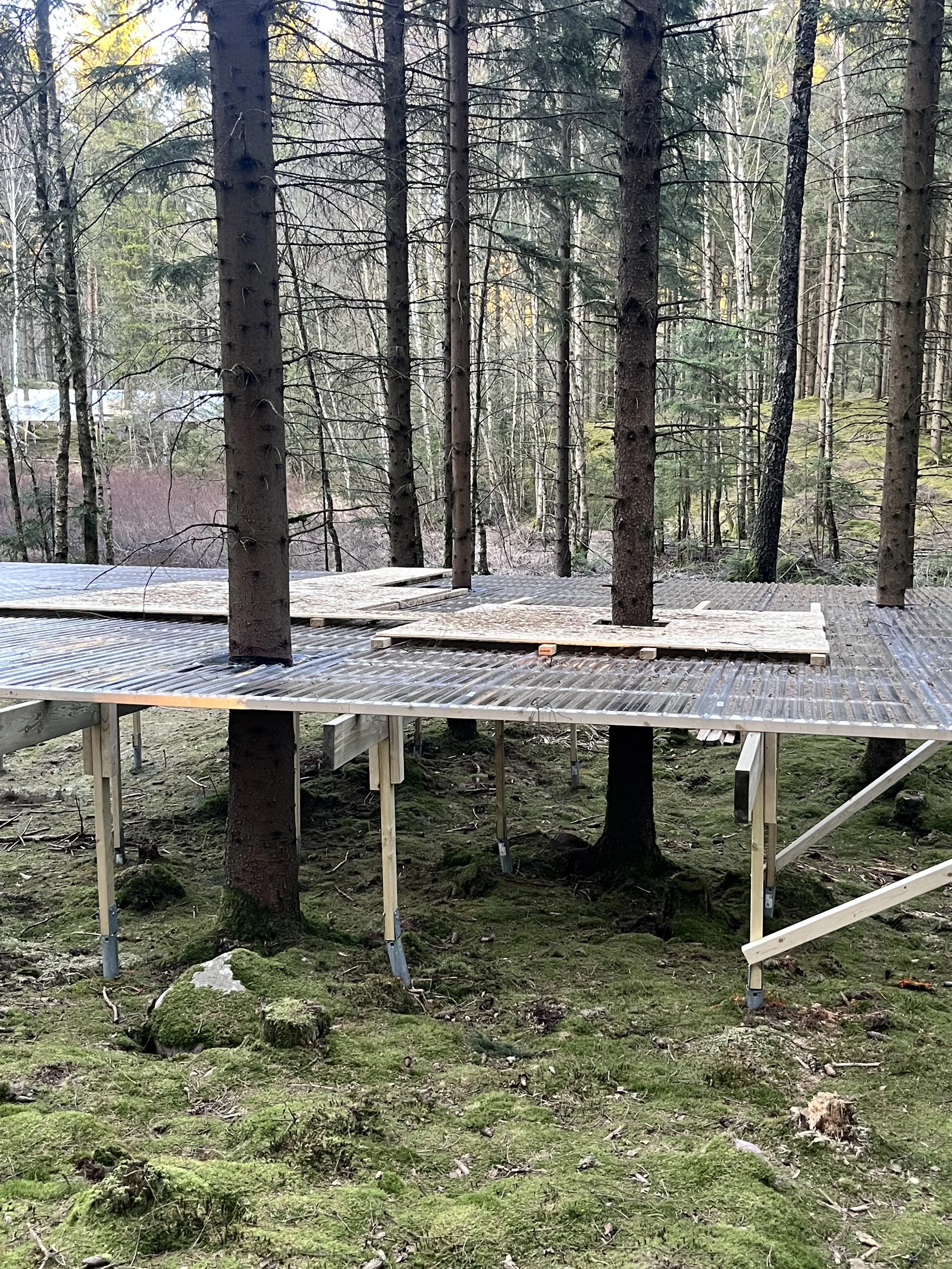
The Tönnersjöheden drought experiment, is a rainfall exclusion study, where by blocking rainfall from reaching the forest soil, we can simulate drought conditions, and tree stress. The induced tree stress, which simulates future environmental conditions, can be used to understand the connection between tree stress and bark beetle attacks.
The first large-scale rainfall exclusion study in demiboreal forests
In the face of a changing climate, boreal forests—our planet's northern lungs—are facing unprecedented drought stress. To understand how these ecosystems will cope, researchers are turning to high-tech "stress tests" known as rainfall exclusion experiments.
By combining these experiments with sap flow sensors and hyperspectral imaging, scientists are building an early-warning system for forest health and bark beetle outbreaks.
1. The Simulated Stress Test: Rainfall Exclusion
Rainfall exclusion experiments (often using "rainout shelters") are controlled studies where researchers physically block a portion of precipitation from reaching the forest floor (Jukuri, 2024).
Why Boreal Forests? These forests are highly vulnerable to warming-driven droughts. Even short-term "summer droughts" can significantly alter soil fungal communities and reduce the vitality of dominant species like Norway spruce and Scots pine (Anyomi et al., 2022; Jukuri, 2024).
The Goal: By simulating future drought scenarios today, we can observe how trees prioritize their remaining water and at what point their natural defenses fail.
2. Monitoring the Pulse: Sap Flow Sensors
To understand tree health in real-time during a drought, researchers use sap flow sensors. These are like "heart rate monitors" for trees, measuring the movement of water (sap) through the xylem.
Measuring Transpiration: Sap flow provides a direct window into how much water a tree is "sweating" (transpiration). Under drought stress, trees close their stomata (tiny leaf pores) to conserve water, causing sap flow to drop (EGUsphere, 2025).
Early Warning Signs: A decline in sap flow often occurs long before needles turn brown. This "hydraulic hysteresis"—a delay or change in the daily water cycle—is a critical indicator of hydraulic stress and potential mortality (EGUsphere, 2025; iForest, 2025).
3. Detecting the "Invisible" Attack: Hyperspectral Cameras
Drought-stressed trees are "sitting ducks" for the European spruce bark beetle (Ips typographus). These beetles target weakened trees, but the initial "green attack" phase is invisible to the human eye.
Beyond RGB: While standard cameras only see Red, Green, and Blue, hyperspectral cameras capture hundreds of narrow light bands.
The Green Shoulder & Red Edge: Scientists use specific indices, such as the Green Shoulder (490–560 nm) and Red Edge (680–780 nm), to detect subtle changes in leaf chemistry and water content (Hellwig et al., 2021; Huo et al., 2024).
High Accuracy: Recent studies show that these hyperspectral indices can detect infested trees with nearly 99% accuracy weeks before any visible symptoms appear (Hellwig et al., 2021; Huo et al., 2024).
4. Linking the Tools: A Unified Monitoring Framework
By integrating these technologies, we move from reactive to proactive forest management:
TechnologyRole in the ExperimentData ProvidedRainfall ExclusionThe "Trigger"Creates controlled drought stress.Sap Flow SensorsThe "Check-up"Measures immediate physiological health and water use.Hyperspectral ImagingThe "Scout"Maps the spread of beetles and stress across the landscape.
Export to Sheets
This multi-layered approach allows researchers to link ground-level physiological data (sap flow) with aerial spectral signatures (hyperspectral). When a drought experiment shows a tree's sap flow is failing, the hyperspectral camera can "learn" what that specific stress looks like from above, enabling us to spot similar patterns across thousands of acres of forest (ISPRS Archives, 2025).

Hitting the ground running
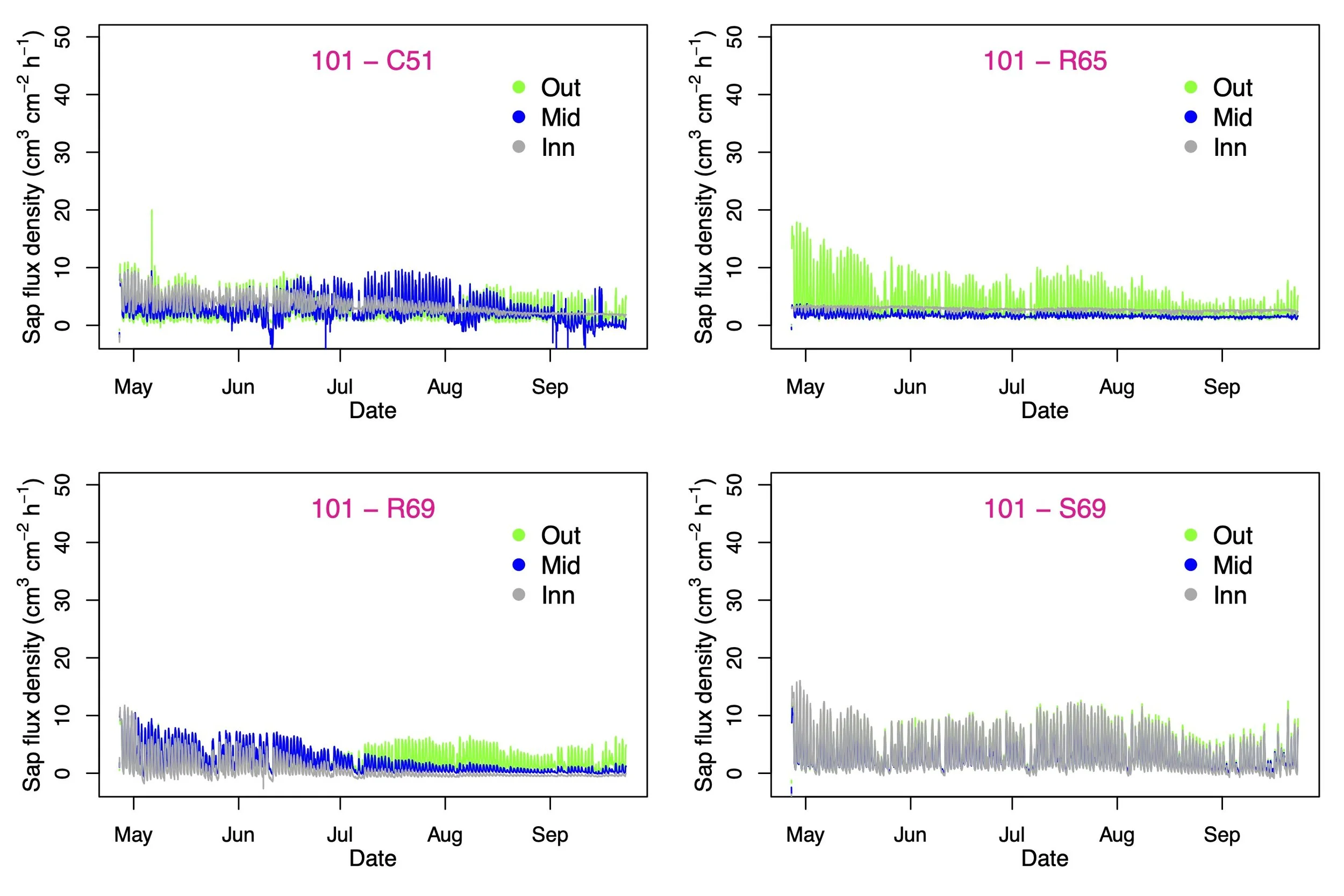
We installed a series of sap flow sensors in various sites that include trees under the roofs, and reference tress (not under the footprint of the roofs).
Take a look at the professionally built roofs!