Publications
-
![]()
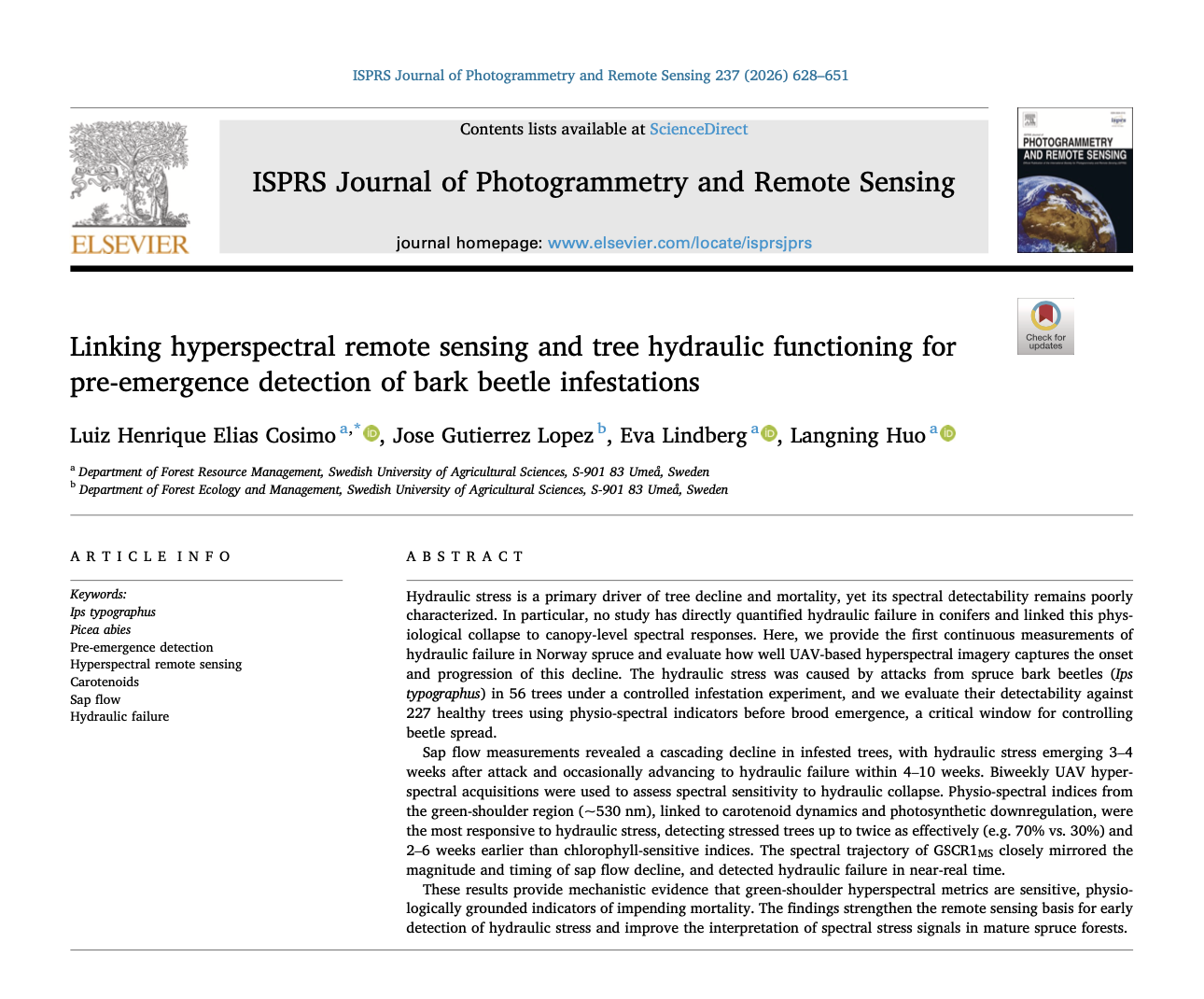
Linking hyperspectral imagery to tree hydraulics
The study investigates how to effectively detect hydraulic stress and impending mortality in Norway spruce trees caused by spruce bark beetle (Ips typographus) infestations, linking direct physiological measurements of tree decline to UAV-based hyperspectral imagery.
This research provides the first direct evidence linking the hydrological collapse of conifers to specific canopy-level spectral responses. We demonstrate that green-shoulder hyperspectral metrics can provide near-real-time, early detection of beetle infestations, offering a critical window for forest managers to intervene before the beetles spread. -
![]()
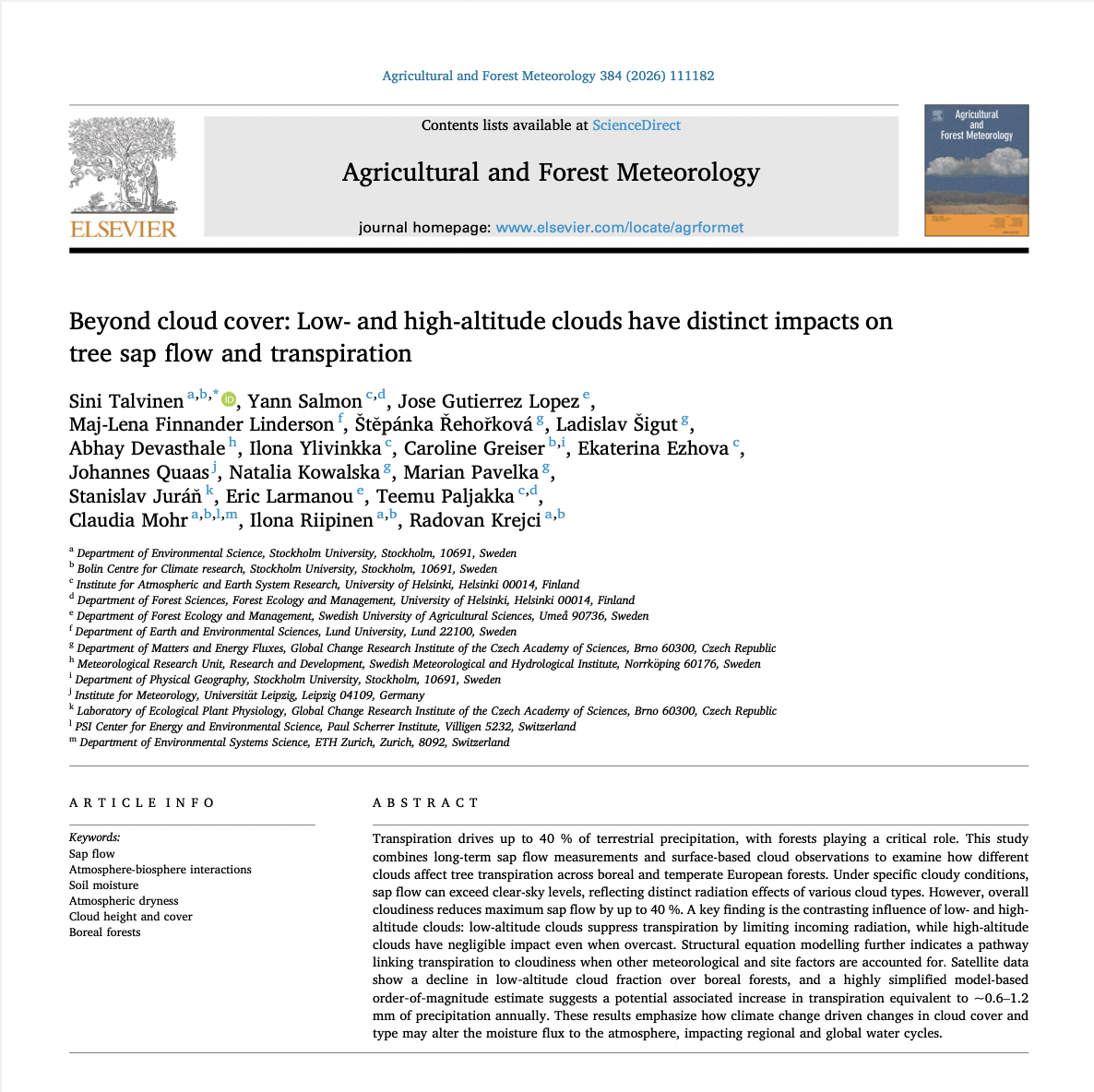
Impacts of could height on tree sap flow and transpiration
In this study, we linked tree sap flow and transpiration, with cloud cover and altitude. We observed that both shape sap flow responses. We additionally observed that low clouds suppress sap flow; high cloud bases can enhance it.
Roles of sap flow drivers differ between low- and high-altitude cloud days.Declining low cloud cover could increase boreal forest transpiration over time.
-
![]()
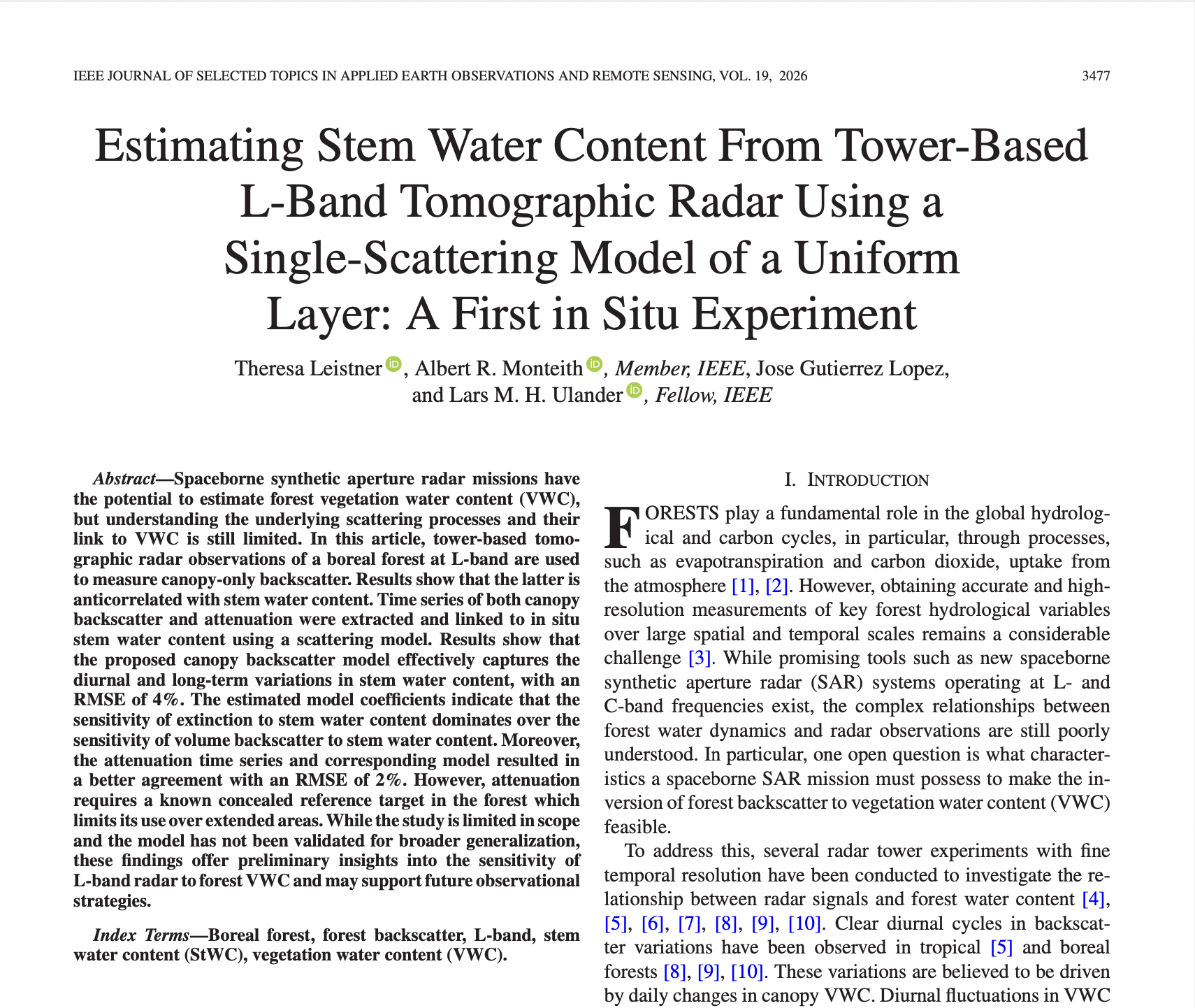
Estimating stem water content with L-band tomographic radar
The study provides preliminary evidence that estimating forest VWC is feasible using tomographic L-band radar platforms. These findings suggest that future spaceborne missions may require vertical separation of canopy and ground backscatter (through tomography or interferometry) and subdaily revisit times to effectively capture diurnal water dynamics in forests.
-
![]()
The Maximum Heat Ratio method
The MHR method provides a more versatile tool for researchers studying forest hydrology. It is ideal for: Fast-growing species that move water rapidly. High-latitude or high-altitude forests where freeze-thaw cycles frequently disrupt standard sensor readings. Low-power, remote monitoring, as the algorithm is easy to implement in standard data loggers without significantly increasing energy. consumption. In short, this method provides a "best of both worlds" solution for measuring tree water use across a much wider range of environmental conditions and species.
-
![JGL_GCB21]()
How drought affects tree transpiration
In this study we highlight that drought response in boreal forests is not a "one-size-fits-all" phenomenon. Instead, it is driven by a complex, codependent interaction between biological traits (species and size) and the physical environment (topography). These insights are critical for predicting how northern forests will respond to the increasing frequency of extreme climate events.
-
![]()
Effects of irrigation on oil palm transpiration
-
![]()
Errors in heater power adjustment in heat dissipation sensors
-
![]()
Can irrigation increase productivity in palm oil?
-
![]()
Can irrigation mitigate drought in palm oil plantations?
-
![]()
Is there an ideal method to partition ET?
-
![]()
Predict winter-time sap flow with stem temperature
In this study we aimed to identify "critical wood temperatures" at which the most sap flow occurs, as this process is vital for both embolism repair and syrup production. We speculate that sap flow is strongly influenced by liquid-to-solid and solid-to-liquid phase changes. Freezing exotherms and thawing endotherms—where volume changes but temperature remains constant—likely explain why flow was highest when temperatures were not changing.
-
![]()
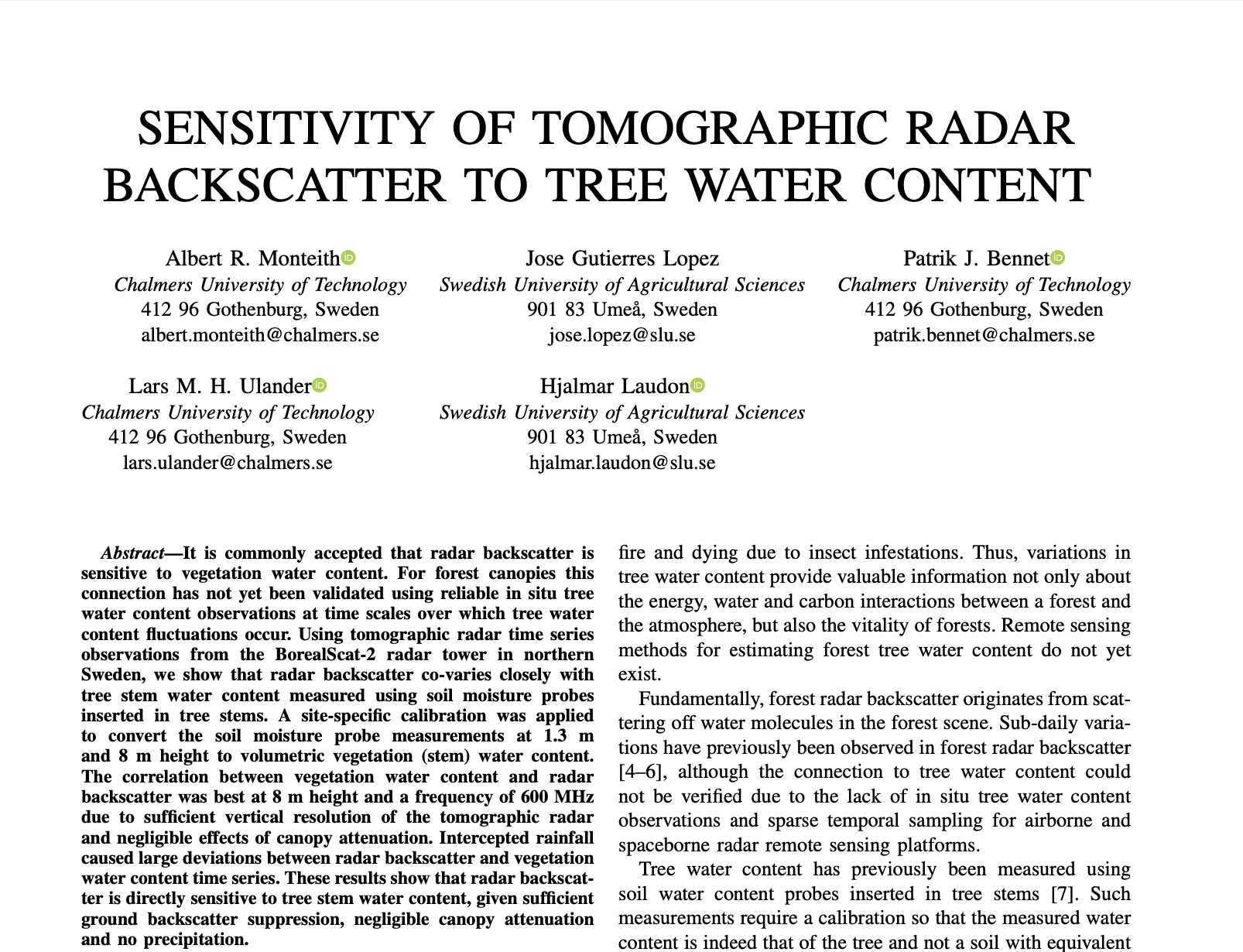
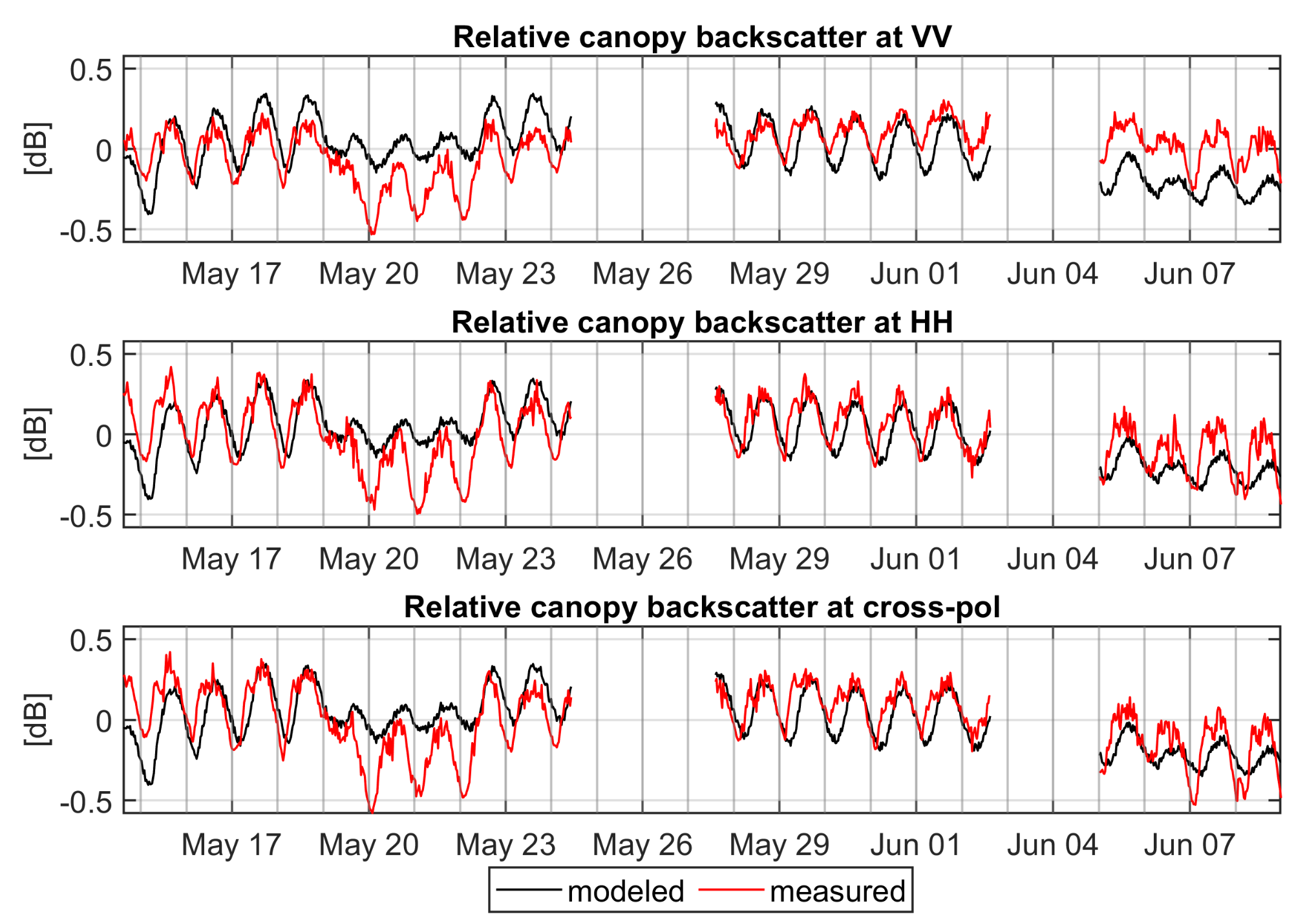
Sensitivity of tomographic radar backscatter to tree water content
Here we demonstrate that radar backscatter is highly sensitive to the water content within tree stems. We used the BorealScat-2 radar tower in Sweden to gather tomographic radar data and compared it to in situ vegetation water content (VWC) measured by calibrated stem water content sensors inserted directly into trees.
We observed that radar backscatter closely co-varies with tree stem water content across sub-daily to monthly timeframes. The strongest correlation was observed at an 8-meter height using the UHF-band (600 MHz) at VV polarization. This specific frequency and height provided the best results due to sufficient vertical resolution and minimal signal attenuation from the upper canopy. Rainfall significantly disrupts these readings, as water intercepted on the surface of the tree structures causes large spikes in radar backscatter.



Working on or submitted
-
![]()
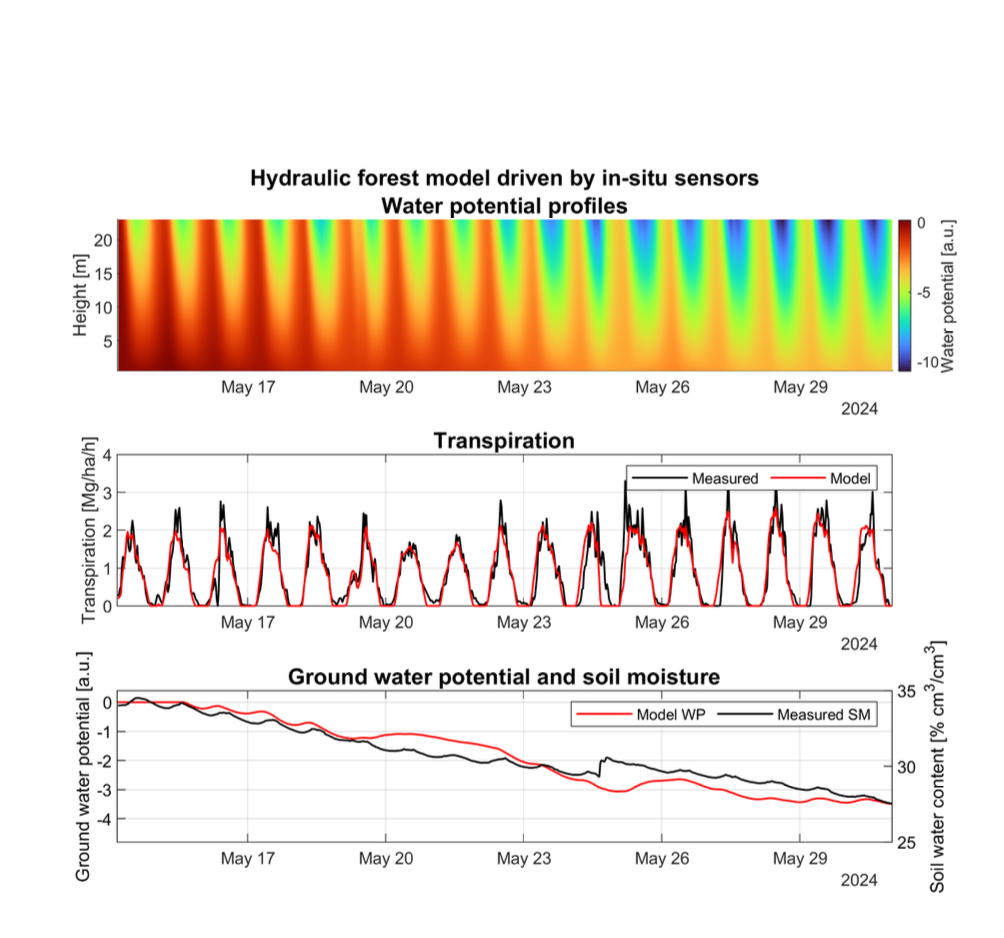
Hydraulic forest model from P band
Bennet et al, are building a hydrological model of ET, from radar measurements at P band. Work to be presented at IGARRS 26 in Washington, DC, USA.
-
![]()
Radar & tree water content
Monteith, et al estimate tree water content using exclusively radar attenuation and backscatter
-
![]()
Tree water content from thermal properties
Gutierrez Lopez, et al, study how to estimate tree water content from thermal properties and water dielectric

Technical reports
-
![]()
The heat dissipation method for sap flow measurements
-
![]()
Construction of heat dissipation probes to estimate sap flow
-
![]()
Manual for the construction and operation of a vacuum cryogenic distilation apparatus
-
![]()
Changing address in SDI12 sensors using Campbell Scientific loggers
Aquí va la descripción


